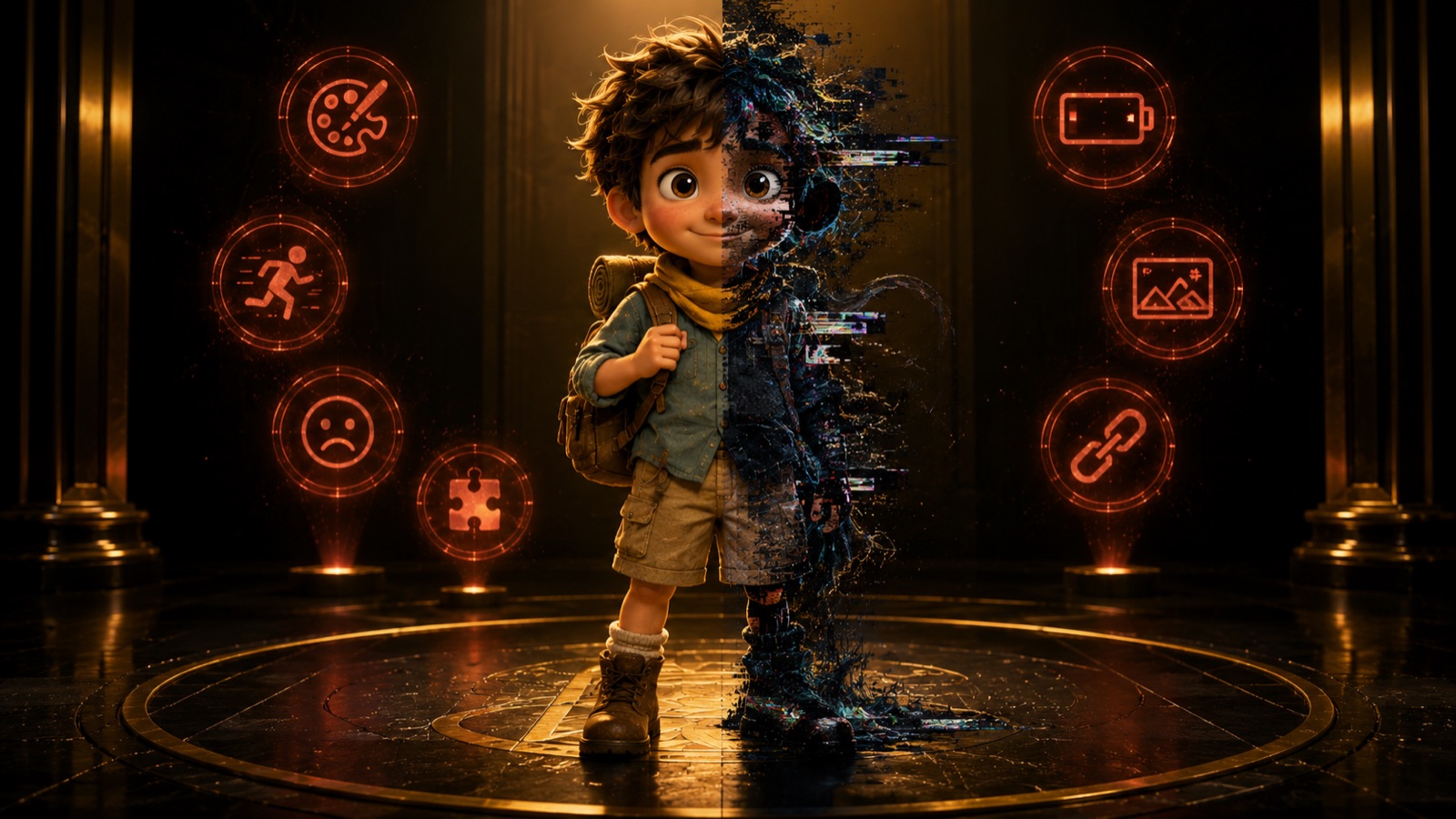
First, the honest frame
Modern animation tools have made something possible that wasn't five years ago: a self-published author can see her characters move without a five-figure budget. We use these tools ourselves, openly, with a human checking every frame — so this isn't a warning against the technology. It's a warning about the seven ways authors get burned when the technology is used carelessly. Every one of these comes from real books we've seen (and a couple of mistakes we made early and learned from).
Mistake 1 — Letting the tool replace your illustrator's style
This is the big one. Generation tools have a default look — glossy, generic, samey — and if nobody fights for your art, that's what you get: your character's name on a stranger's face. The fix is a style analysis before any animation starts: your palette extracted, your line quality matched, your character's features written down as a locked list. If a provider can't show you a before/after where the book page and the animated frame are unmistakably the same art, keep looking.
Mistake 2 — Character drift between scenes
Scene one, the bow is on the left. Scene three, it's on the right. Scene five, the boots changed colour. Children notice — they're the most detail-obsessed audience on earth. Serious work locks the character's distinguishing features and checks every retry against that list, because the tools will drift if nobody stops them.
Mistake 3 — Not checking hands, eyes, and teeth at full zoom
The classic tells of careless generated animation live in the details: six fingers, warped teeth, eyes that swim. At thumbnail size everything looks fine; at 200% zoom the problems appear. Insist that a human reviews frames at full resolution before anything ships. A parent may not name what's wrong with a frame, but they feel it — and they scroll past.
Mistake 4 — Complex motion instead of charming motion
Authors ask for running, flying, action. But the tools are at their best with simple, warm movement — a wave, a hug, leaves falling, light changing — and at their worst with complex physical action. In children's content, charm beats spectacle anyway. A character who blinks and smiles convincingly sells more books than a character who backflips unconvincingly.
Mistake 5 — Publishing the first output
First outputs are drafts. The difference between "obviously AI" and "how did they make this?" is almost always iteration: rejecting the takes with drift, regenerating with corrections, cutting the seconds that don't hold up. If a service's price only makes sense because they ship the first render, the price isn't real.
Mistake 6 — Ignoring the rights question
Two rights questions matter. First: do you own the finished film outright? (You should — in writing, 100%.) Second: was your own illustration used with your illustrator's licence in order? If you paid for your book art, you almost certainly hold what you need — but check your illustrator agreement before animating, and never let a provider keep ownership of work made from your book.
Mistake 7 — Hiding how it was made
Some authors worry about the AI question and hope nobody asks. Somebody always asks. The answer that works is the honest one, said plainly: modern tools, human direction, your original art as the source, every frame checked by a person. Readers forgive technology; they don't forgive feeling deceived. We answer this question directly on every call, and it has never once cost us an author who saw the work first.
The pattern behind all seven
Every mistake above is the same mistake wearing different clothes: no human standing between the tool and your book. The technology is a fast brush. It still needs someone who cares about your story holding it.