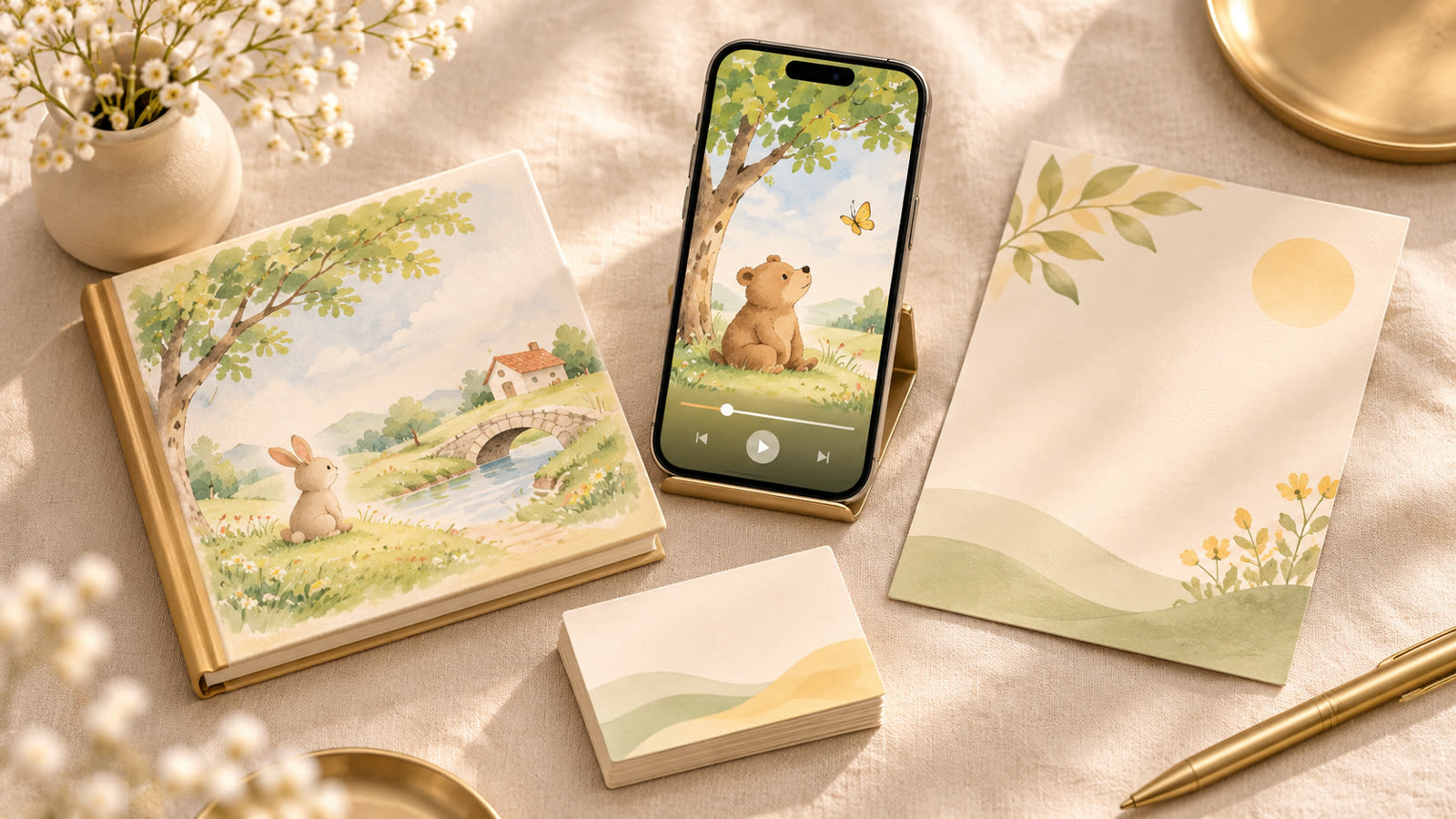
The mistake: treating it as a post
Most authors who buy a trailer put it on Instagram once, watch it get 400 views, and conclude video does not work. The video was fine. The deployment was one post.
A 15-second animated clip is not a post. It is a file you own, and the return comes from how many places it goes to work. Below is what to do with one file over thirty days. None of it costs anything beyond the clip itself.
Week 1 — Fix the places people already land
Before posting anything new, put the clip where traffic already arrives and currently finds nothing moving.
- Your Amazon A+ content (if you have brand registry). A moving module on a book page is still rare in children’s titles.
- Your author website header. Above the fold, autoplay muted, looping.
- Your email signature — a thumbnail with a play triangle, linked. You send more emails than you think.
- Pinned to the top of every social profile. Instagram, Facebook, TikTok, and as a YouTube Short.
- Your Goodreads author profile and your newsletter welcome email.
This takes one afternoon and it is the highest-return part of the whole exercise, because these are people already looking for you.
Week 2 — Cut one file into a week of content
You do not need more footage. You need more framings of the same footage. From one 15-second clip:
- The clip itself, clean, with no caption burned in.
- The before/after — your illustration on the left, the animated version on the right. This consistently outperforms the clip alone, because the transformation is the story.
- The reaction — film a child watching it. Their face, not the screen.
- The process post — this is the page from my book; this is what it became.
- The behind-the-scenes — a photo of the kitchen table where the book was written, with the clip as the payoff.
- The question post — clip plus should I animate the whole book? People answer questions.
Six posts, one asset, zero additional spend.
Week 3 — Send it to the people who book and stock you
This is where the money actually is, and almost nobody does it.
- School librarians. A 15-second clip turns your pitch email into something they can forward. Author visits commonly pay $300–$600 — one booking pays for the clip several times over. The full approach is in how to get booked for school visits.
- Independent bookshops. I have a 15-second animated clip you can run on your in-store screen or socials if you stock it. You have just made it easier for them to sell you.
- Local press and parenting blogs. A story with embeddable video gets picked up more often than one with a cover JPEG.
- Festival and book fair applications. Organisers choosing between applicants pick the one who looks like a working professional.
Week 4 — Put small money behind what already works
Only now, and only on the post that performed best organically. Boosting a video the algorithm has already rewarded is cheap; boosting a bad post is a donation. A modest local budget targeting parents of children in your book’s age band, pointed at your email signup rather than straight at Amazon, builds something you keep.
And be honest about the goal. A trailer rarely produces a direct, trackable sale. What it reliably produces is permission to be taken seriously — by a librarian, a bookshop, a festival, or a parent deciding between your book and the one next to it.
What $350 actually buys, in plain terms
At our entry price the teaser is $350 — $175 to start, $175 when you approve it. Set against the list above:
- One school visit at $400 covers it with change left over.
- One independent bookshop that stocks ten copies covers it.
- Six weeks of social content you did not have to invent.
- An asset with no expiry — you own it outright and use it for every future launch.
That is the honest case. It is not a magic sales machine. It is a reusable asset that makes every other thing you were already doing land harder.
What will not work
Three things we watch authors try that reliably waste the clip:
- Posting it once and waiting. Covered above. It is the main one.
- Pointing it straight at a buy link. Strangers rarely buy a children’s book on first exposure. Point it at a follow, a newsletter, or a free sample page.
- Making it about you. Thrilled to share my debut is for people who already care. Open on the character.