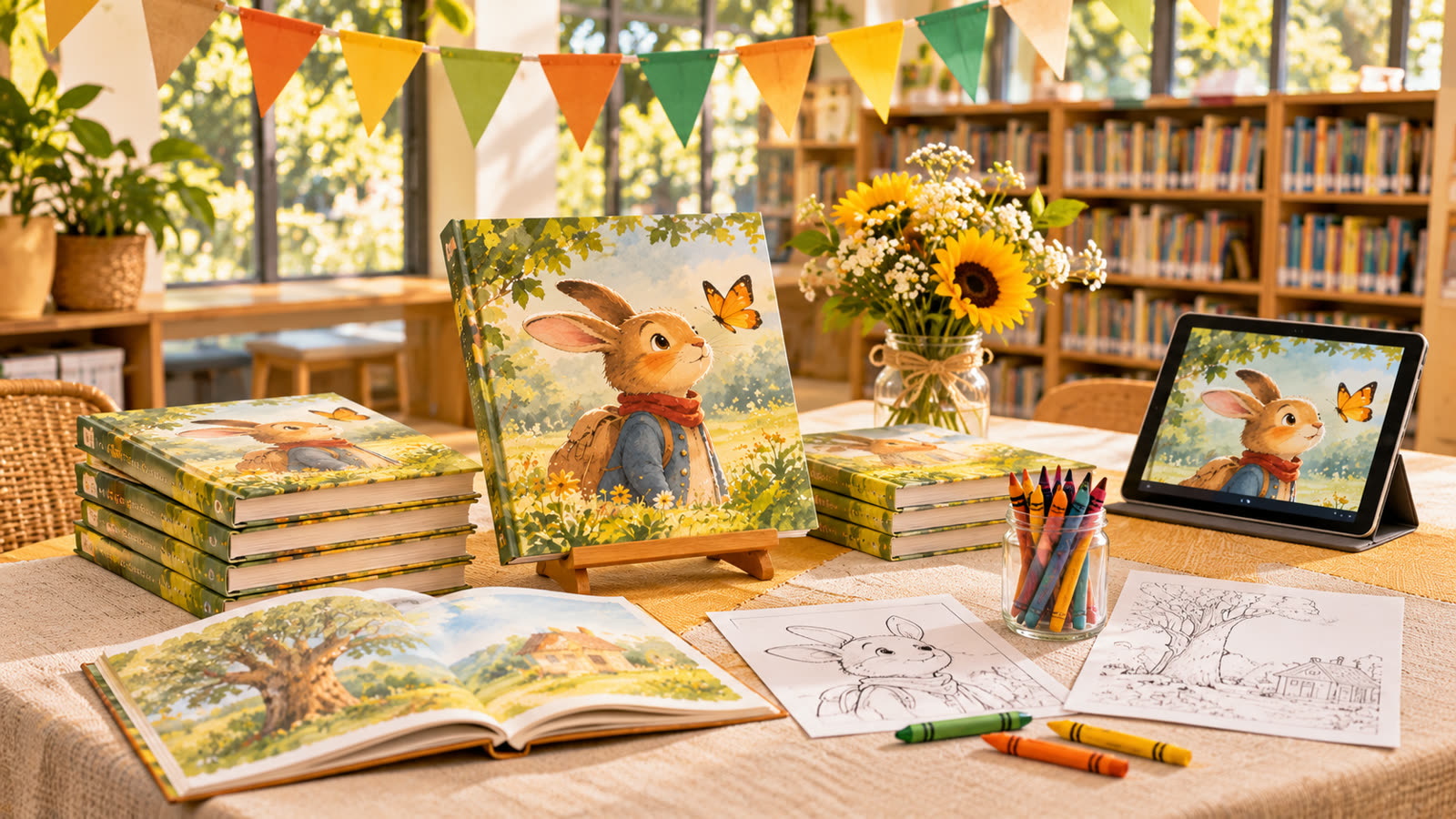
What a launch is actually for
Not sales on the day. A children’s book launch exists to create the proof you will use for the next twelve months: photographs of real children with your book, a quote from a librarian, a local press mention, and the first handful of reviews. Judge the day on what you leave with, not what you sold.
That reframing changes every decision below.
Six weeks out
- Lock the date and the venue. A library, an independent bookshop, a nursery, a community hall or a café with space. Libraries are the most underused and often free — they want the footfall.
- Order your copies. Allow for delivery going wrong. It frequently does.
- Decide the one thing children will do. A launch where children only listen is a launch where children leave. Colouring sheets of your character, a drawing competition, a dress-up, a simple craft.
- Email local press and parenting bloggers. Six weeks is right for monthlies. A local angle beats a book angle: local author, local school, local story.
Three weeks out
- Invite in person or by name. A public post invites nobody in particular. Message individuals.
- Ask your venue to put it in their newsletter and on their noticeboard. Their list is bigger than yours.
- Line up your proof-gatherer. One person whose entire job on the day is photographs and short video. Not you — you will be busy and you will end up with nothing.
- Prepare the read-aloud. Pick the two or three best pages. Nobody reads the whole book at a launch.
The week of
- Sort payment. Card reader and cash. Losing a sale because someone has no cash is an avoidable annoyance.
- Print a simple order form for anyone who wants signed copies later, and for schools who want to book you.
- Prepare a one-page visit menu to hand to any teacher who comes. This is where launches turn into income.
- Set up something playing on loop. A screen or tablet running your character draws children across a room better than a table of books.
Launch day, in order
- Welcome and read — two or three pages, ten minutes maximum for under-sevens.
- The activity — this is the actual event. Children busy, parents relaxed and browsing.
- Signing — ask each child their name and write it. The personalisation is the reason they keep the book.
- Collect proof — photos, a short video of children listening, and one quote from the librarian or host.
- Ask for the next thing — every teacher, every parent who works at a school. One sentence: would your school like a reading?
Launch party ideas that work for picture books
- A character meet-and-greet — even a cardboard stand-up of your character to photograph children beside.
- A story-time trail — pages posted around the venue so children walk the book.
- A drawing wall — children draw your character; you display every one. Parents photograph it, which does your marketing for you.
- A giveaway that is not the book — bookmarks, stickers, a colouring sheet. It goes home and stays visible.
- A screen running your character — the single biggest difference between a quiet table and a crowded one.
The week after — where most launches are wasted
Almost everyone stops here, and this week is worth more than the day itself.
- Post the proof. Children listening, the drawing wall, the signing queue. This is your best content of the year.
- Email everyone who came with one photo and one link to leave a review. Ask plainly; most people will.
- Follow up every teacher within three days, while they still remember the room.
- Send the local paper your photos. They often run the follow-up even if they skipped the preview.
- Write down which page children reacted to. That page is your marketing from now on.