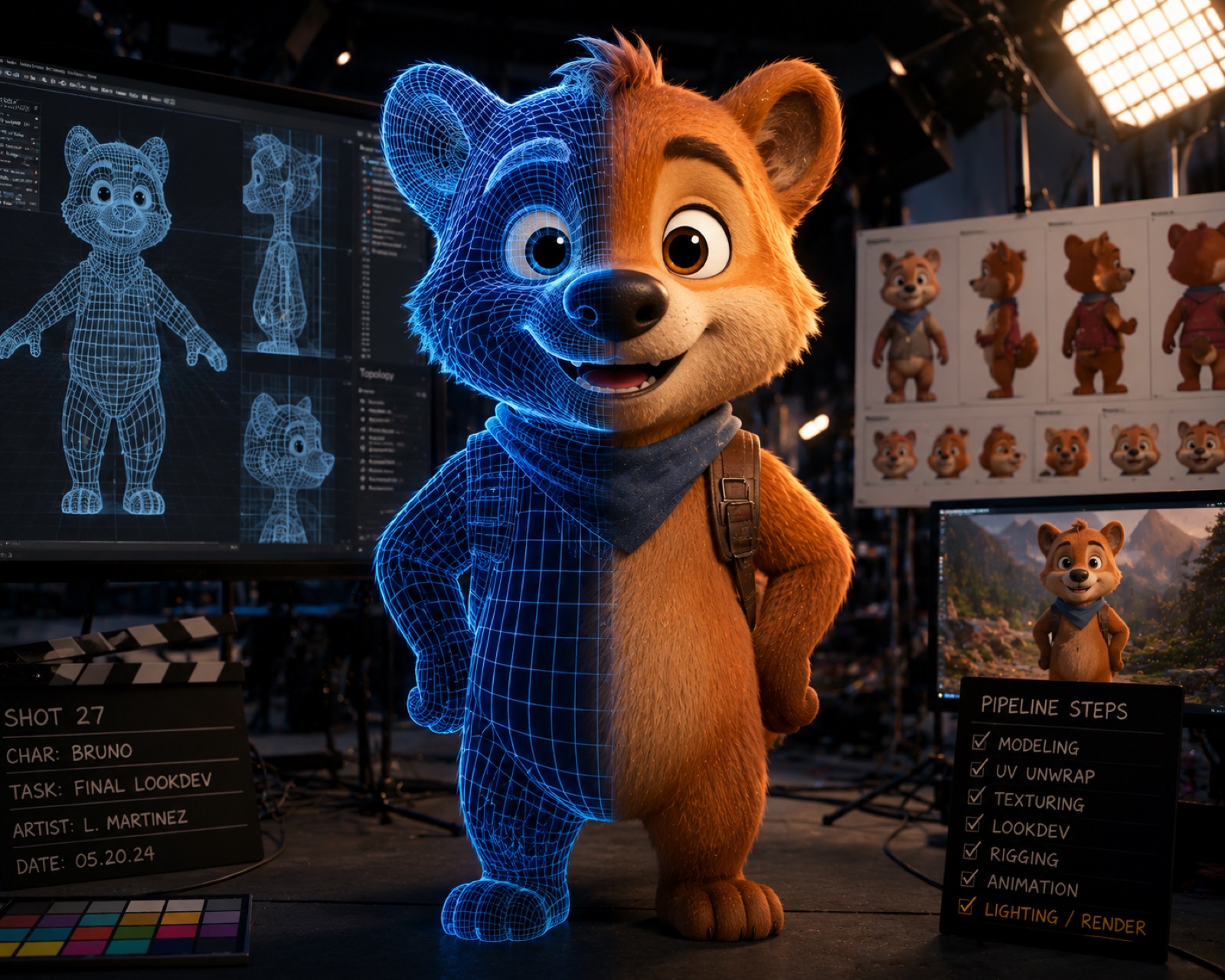
First, the good news: your book is probably ready already
If your book is illustrated — even if it only exists as a PDF from your illustrator — you have everything an animation studio needs to start. You do not need special files, a storyboard, or any technical knowledge. Authors regularly come to us with nothing but a printed book and leave with a film. The single most useful thing you can gather before talking to anyone is your original illustration files (the ones your illustrator delivered), because higher-resolution art gives the animation more detail to work with.
Step 1 — Decide what "animated" means for your book
Authors usually mean one of three different things, and they cost very different amounts:
- A character preview — your main character brought to life in a single styled still or a short motion moment. This is what we give away free, delivered within 24 hours, because it's the fastest way for an author to judge whether animation honours their art.
- A social scene — a 15–30 second cinematic scene from your book, made for Instagram, TikTok, Facebook and school-visit pitches. This is the workhorse: long enough to make a stranger feel something, short enough to hold attention. Ours is $697, delivered in 7–10 days, in all three formats (vertical, square, widescreen).
- A full trailer or film — a produced piece with music, pacing and a story arc, from $4,997. Most authors start with a social scene and upgrade later; every dollar of the smaller piece credits toward the bigger one.
Step 2 — The style conversation (this is the one that matters)
The first question almost every author asks us is: "Will animation ruin my illustration style?" It's the right question. You spent years and real money on that art, and some studios will quietly replace it with a generic house look.
Here is what to demand from any studio, including us: the animation should be built from your existing illustrations, not redrawn from scratch. If your book is soft watercolour, the film should be soft watercolour. Ask to see a before/after from a real client — the actual book page next to the animated scene. If a studio can't show you one, that tells you something.
When we animated Two Brave Hearts and a Little Bear by LaToya Lewis, every scene was built from her illustrator's watercolour pages — same palette, same bears, same stitching on the teddy bears. That's the standard your art deserves.
Step 3 — What actually happens in production
Once you hand over your illustrations, a serious studio will:
- Analyse your art style — palette, line quality, proportions, the character details that must never drift (the bow on the left side, the gap tooth, the yellow boots).
- Animate a key scene — motion is added carefully: a walk, a hug, leaves falling, light changing. Charm beats spectacle in children's content, always.
- Quality-check against your book — every frame compared with the source art. You should get approval before anything is final.
- Deliver in the formats you'll actually use — vertical for Reels and TikTok, square for feeds, widescreen for YouTube and school projectors.
Step 4 — Timeline: what's realistic
For a single scene, 7–10 days is a healthy standard. A full trailer runs a few weeks. Be suspicious of both extremes — same-day full trailers usually mean template work with your character pasted in, and multi-month timelines for a 30-second piece usually mean you're at the back of someone's queue. If you have a launch date, work backwards: a scene ordered a month before launch arrives with room to spare.
What it costs, honestly
Across the industry you'll see everything from $200 gig-site trailers (template slideshows, usually) to $20,000+ traditional studio work. Our published ladder is simple: free 24-hour character preview → $697 social scene → trailers from $4,997, and the smaller purchase always credits toward the larger one. Whatever studio you choose, insist on two things in writing: a fixed price before work starts, and confirmation that 100% of the copyright in the finished film belongs to you.
The question underneath all of this
An animated scene isn't really a video — it's the difference between telling a school "I wrote a book" and showing a classroom your character moving on the projector. It's the reason a stranger stops scrolling. One of our authors' characters is now part of a primary school's summer camp programme because the headmistress could watch the book, not just read a pitch letter. That's the actual product: your story, impossible to scroll past.